# nerf-pytorch
**Repository Path**: Fj1225815367/nerf-pytorch
## Basic Information
- **Project Name**: nerf-pytorch
- **Description**: mirror of nerf pytorch
- **Primary Language**: Python
- **License**: MIT
- **Default Branch**: master
- **Homepage**: None
- **GVP Project**: No
## Statistics
- **Stars**: 0
- **Forks**: 2
- **Created**: 2023-11-14
- **Last Updated**: 2023-11-14
## Categories & Tags
**Categories**: Uncategorized
**Tags**: None
## README
# NeRF-pytorch
[NeRF](http://www.matthewtancik.com/nerf)(神经辐射场)是一种获得最新结果的方法,用于合成复杂场景的新视图。以下是此存储库生成的一些视频(下面提供了预训练模型):

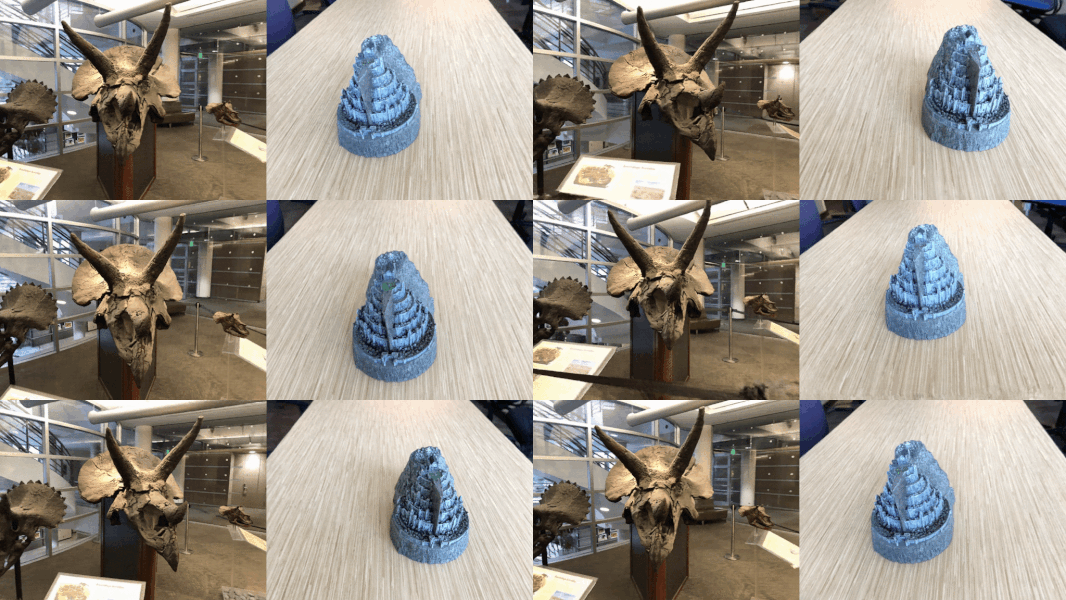
该项目是 [NeRF](http://www.matthewtancik.com/nerf)是一个可信任的 PyTorch 实现,它在运行速度提高 1.3 倍的同时重现了结果。该代码基于作者的 Tensorflow 实现 [此处](https://github.com/bmild/nerf),并经过测试以在数值上匹配它。
## 安装
```
git clone https://github.com/yenchenlin/nerf-pytorch.git
cd nerf-pytorch
pip install -r requirements.txt
```
依赖 (单击以展开)
## 依赖包
- PyTorch 1.4
- matplotlib
- numpy
- imageio
- imageio-ffmpeg
- configargparse
LLFF 数据加载器需要 ImageMagick。
如果您想在自己的真实数据上运行,您还需要设置 [LLFF 代码](http://github.com/fyusion/llff)(和 COLMAP)来计算姿势。
## 怎么运行?
### Quick Start
下载两个示例数据集的数据:“lego”和“fern”
```
bash download_example_data.sh
```
要训练低分辨率的“lego”NeRF:
```
python run_nerf.py --config configs/lego.txt
```
训练 100k 迭代(在单个 2080 Ti 上 训练4 小时)后,您可以在“logs/lego_test/lego_test_spiral_100000_rgb.mp4”中找到以下视频。

---
要训练低分辨率的“fern”NeRF:
```
python run_nerf.py --config configs/fern.txt
```
经过 200k 次迭代训练(在单个 2080 Ti 上训练 8 小时)后,您可以在“logs/fern_test/fern_test_spiral_200000_rgb.mp4”和“logs/fern_test/fern_test_spiral_200000_disp.mp4”中找到以下视频

---
### 更多数据集
要体验论文中介绍的其他场景,请在[此处](https://drive.google.com/drive/folders/128yBriW1IG_3NJ5Rp7APSTZsJqdJdfc1)下载数据。且放置下载的数据集在以下目录结构:
```
├── configs
│ ├── ...
│
├── data
│ ├── nerf_llff_data
│ │ └── fern
│ │ └── flower # downloaded llff dataset
│ │ └── horns # downloaded llff dataset
| | └── ...
| ├── nerf_synthetic
| | └── lego
| | └── ship # downloaded synthetic dataset
| | └── ...
```
---
在不同的数据集上训练 NeRF:
```
python run_nerf.py --config configs/{DATASET}.txt
```
用 `trex` | `horns` | `flower` | `fortress` | `lego` | 等等替换 `{DATASET}` .
---
测试在不同数据集上训练的 NeRF:
```
python run_nerf.py --config configs/{DATASET}.txt --render_only
```
用 `trex` | `horns` | `flower` | `fortress` | `lego` | 等等替换 `{DATASET}`.
### 预训练模型
您可以在[此处](https://drive.google.com/drive/folders/1jIr8dkvefrQmv737fFm2isiT6tqpbTbv)下载预训练模型。将下载的目录放在“./logs”中,以便稍后测试。有关示例,请参阅以下目录结构:
```
├── logs
│ ├── fern_test
│ ├── flower_test # downloaded logs
│ ├── trex_test # downloaded logs
```
### 再现性
测试确定在不同的分支 `reproduce`中关于功能和循环训练是和官方实现相匹配的。可以检查它并运行测试:
```
git checkout reproduce
py.test
```
## 方法
[NeRF:将场景表示为用于视图合成的神经辐射场](http://tancik.com/nerf)
[Ben Mildenhall](https://people.eecs.berkeley.edu/~bmild/)\*1,
[Pratul P. Srinivasan](https://people.eecs.berkeley.edu/~pratul/)\*1,
[Matthew Tancik](http://tancik.com/)\*1,
[Jonathan T. Barron](http://jonbarron.info/)2,
[Ravi Ramamoorthi](http://cseweb.ucsd.edu/~ravir/)3,
[Ren Ng](https://www2.eecs.berkeley.edu/Faculty/Homepages/yirenng.html)1
1UC Berkeley, 2Google Research, 3UC San Diego
\*奉献相同的贡献
 > 一个神经辐射场是一个简单的全连接网络(权重是 ~5MB),这个网络经过训练,可以使用渲染损失来再现一个场景的输入视图。该网络直接从空间位置和观看方向(5D 输入)映射到颜色和不透明度(4D 输出),充当“体积”,因此我们可以使用体积渲染来得到不一样的渲染新视图。
## 引文
感谢作者的惊人成果:
```
@misc{mildenhall2020nerf,
title={NeRF: Representing Scenes as Neural Radiance Fields for View Synthesis},
author={Ben Mildenhall and Pratul P. Srinivasan and Matthew Tancik and Jonathan T. Barron and Ravi Ramamoorthi and Ren Ng},
year={2020},
eprint={2003.08934},
archivePrefix={arXiv},
primaryClass={cs.CV}
}
```
但是,如果您发现此实现或预训练模型有帮助,请考虑引用:
```
@misc{lin2020nerfpytorch,
title={NeRF-pytorch},
author={Yen-Chen, Lin},
publisher = {GitHub},
journal = {GitHub repository},
howpublished={\url{https://github.com/yenchenlin/nerf-pytorch/}},
year={2020}
}
```
> 一个神经辐射场是一个简单的全连接网络(权重是 ~5MB),这个网络经过训练,可以使用渲染损失来再现一个场景的输入视图。该网络直接从空间位置和观看方向(5D 输入)映射到颜色和不透明度(4D 输出),充当“体积”,因此我们可以使用体积渲染来得到不一样的渲染新视图。
## 引文
感谢作者的惊人成果:
```
@misc{mildenhall2020nerf,
title={NeRF: Representing Scenes as Neural Radiance Fields for View Synthesis},
author={Ben Mildenhall and Pratul P. Srinivasan and Matthew Tancik and Jonathan T. Barron and Ravi Ramamoorthi and Ren Ng},
year={2020},
eprint={2003.08934},
archivePrefix={arXiv},
primaryClass={cs.CV}
}
```
但是,如果您发现此实现或预训练模型有帮助,请考虑引用:
```
@misc{lin2020nerfpytorch,
title={NeRF-pytorch},
author={Yen-Chen, Lin},
publisher = {GitHub},
journal = {GitHub repository},
howpublished={\url{https://github.com/yenchenlin/nerf-pytorch/}},
year={2020}
}
```